
Calculus provided relief from the two-thousand-year decline in mathematics that proceeded the death of Archimedes.1 With its tools to analyze motion, change, and infinite series, calculus was a novel interpretation of reality and, to many, impossible to understand. Probably more often than not, students have gone into studying this subject with rumors of its difficulty floating in their mind, and, accordingly, they find it intractable. After years of calculus study, however, I find this widespread impression to be false.
I cannot generalize my claim over the entirety of calculus just yet, considering I am still only on Calc II, but I thoroughly believe that what I have to say is applicable to all students who are new to the subject.
Background
Since the 10th grade, I have been rigorously studying calculus. This was an unconventional place to begin since most students start learning the subject as a junior, senior, or college student (if they learn it at all, that is). Despite the breach in etiquette, however, my understanding flourished.
Having this reasonably smooth journey into calculus, I never quite understood people’s hesitation with the subject. Even stranger, I have heard some describe the transition of algebra to calculus as orders of magnitude more difficult than the transition from arithmetic to algebra. For me, though, I had more difficulty with algebra in 6th grade than calculus in 10th.
Understanding that I do not even remotely qualify as a genius, why was it that my 14-year-old self had no trouble with calculus, but a multitude of older students struggle with it.
The Proliferated Rumor
One reason that was alluded to earlier is culture. There is no shortage of people who will tell you that calculus is complicated, that it is not intuitive, that it is next-to-impossible to understand. It is probably more difficult to find someone to say otherwise.
Let me make my stance clear: I am not arguing that calculus is immediately accessible; I am arguing that the subject is fundamentally simple and not far from intuition. If this was not the case, humans probably never would have discovered it!
The other problem, of course, is having a teacher who is not enthusiastic about it themselves or perhaps doesn’t understand it. This is far too common. With a bad teacher, the student cannot parse the subject and will be left with the impression that the difficulty is an inherent property of the subject, instead of just the environment he or she learned it in.
My philosophy, which I think applies to nearly everything, is that complex things are usually just a lot of simple things densely packed together. It is your job as a student to unpack it.
If the reader is just starting calculus, I recommend skipping to the General Advice section below. The next two sections will be explanations of concepts commonly considered to be hard, but are actually straightforward.
Delta-Epsilon Proofs
Of all the concepts discussed in Calc I, the concept considered hardest is the 

What is it?
Everything in math needs to be shown that it logically follows from the basic axioms of math. We demonstrate this via mathematical proofs. The
Definition
The definition of a limit is as follows (where 

Let 


if given any number 

 whenever satisfies
Explanation
To the novice, this can be unsightly; however, this is actually quite simple.
Limits are trying to find the value that
In simple terms, the definition states that no matter how small some number 


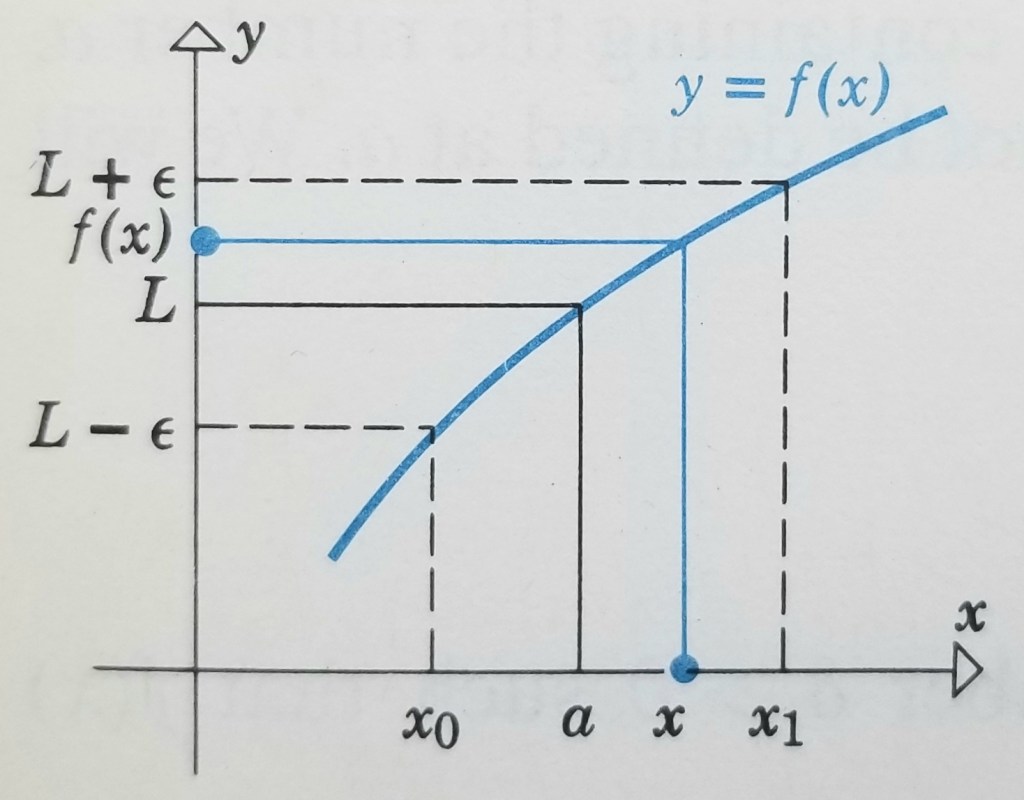
Below illustrates the
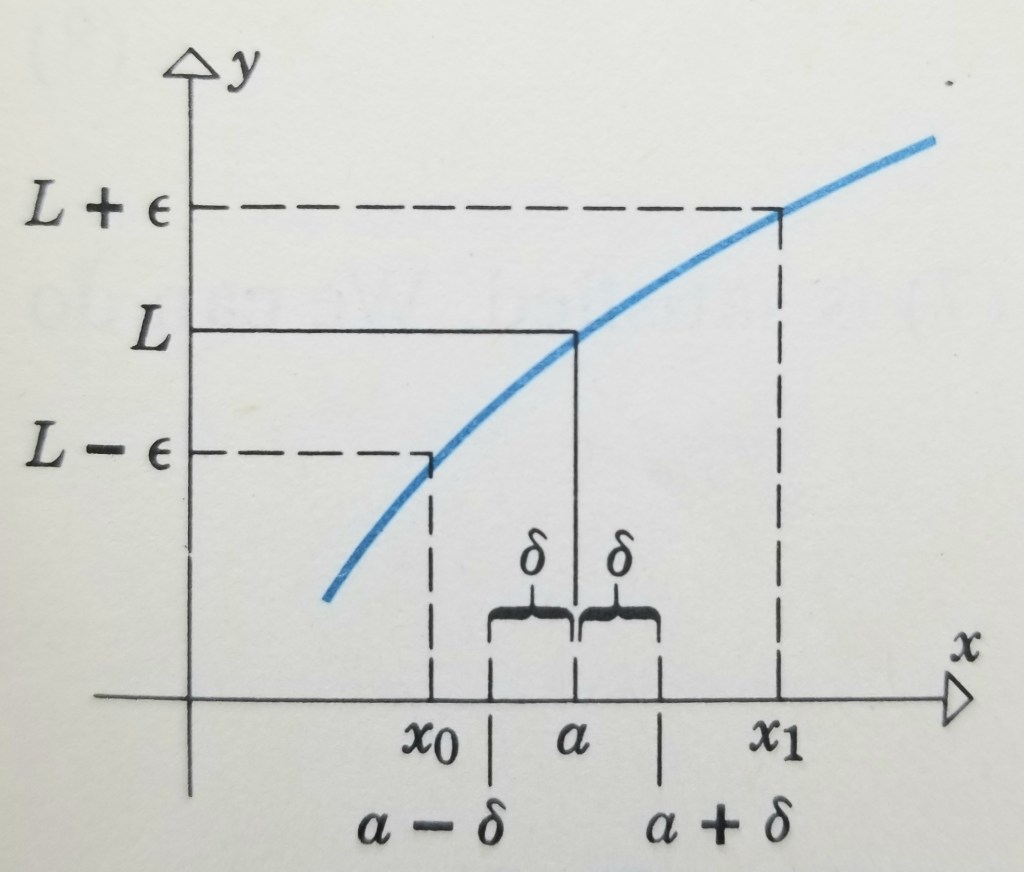
Why is the 

The 

The
What the problems consist of and how to solve them
Delta-epsilon proof problems that are given to the already struggling student generally look like this: “Prove [insert some limit here].”
To solve these, you will have to show that the given limit statement obeys the limit definition, viz. for every
That’s literally all. You just have to find a formula that connects
The trickiest part, however, is going about finding the formula. To do so, you will have to algebraically manipulate the
This will make more sense with some…
Examples
Prove

Soln. We must show that given any positive number 

whenever

As stated earlier, to find the formula for

or

Remember: We have to choose a value for 

We have just shown that for a given
Done! It has been proven.
To analyze what we just did: We assumed that for any
Limit proofs of linear functions are about as easy as
A bit harder of an example
Prove

Soln. This is more abstract than the last one, but our goal is still the same. Assume we are given an

whenever

We need to manipulate the

Okay, so we have our 


Let 

The boundary value that 

This is our boundary wherein the product

Now, we need a range of 
But, hold on. We had put 


With this, no matter what value of
This value of 

Thus, for the value of


We interpret this result as “Whatever value is smaller, we make delta equal to that.” This way, (i) is satisfied whenever (ii) is satisfied.
Q.E.D.
N.B. The choice of 

Harder example
Prove

Soln. We assume that for any given

whenever

We must manipulate the 

We have rewritten (i) to have (ii) as a factor. But… oh no. Not again! We have a non-constant factor, 


Let

The range of 


Thus, 

We need to choose a restriction of 


But hold on… we made 

With this, no matter what value of 


Q.E.D.
In conclusion of 
For the delta-epsilon proof, the goal is to choose 
Optimization Problems
Problems concerned with finding the most optimal way to perform a task are called optimization problems.
It’s strange to learn that many people find these to be difficult, considering a large swath of optimization problems are simply finding the largest or smallest value of a function and determining where the value occurs. I personally love this part of calculus. It requires logic and a healthy amount of creativity.
What are you required to do?
For optimization problems, you will have a constraint that is used to isolate one variable and a formula/function to maximize or minimize. You thus do as follows: Using the constraint, express the function in terms of one independent variable. Find the range of values that the variable can equal such that the context of the problem is satisfied. Differentiate the function. Set the derivative equal to zero and find the value of the variable that leads to such a condition being true. You now have candidates for the maximum or minimum. Find which one is the relevant extremum.
Why do we set the derivative equal to zero?
Since we are trying to find the relative extrema of functions, we have to solve for points that have the properties of relative extrema. All points that are relative maxima or minima have derivatives of zero. In other words, the tangent line at a relative extremum is horizontal. We thus solve for points that have derivatives of zero and narrow down the candidates to the actual extremum.
Examples
With reference to the diagram below:
Find the dimension of a rectangle with perimeter 100ft whose area is as large as possible.
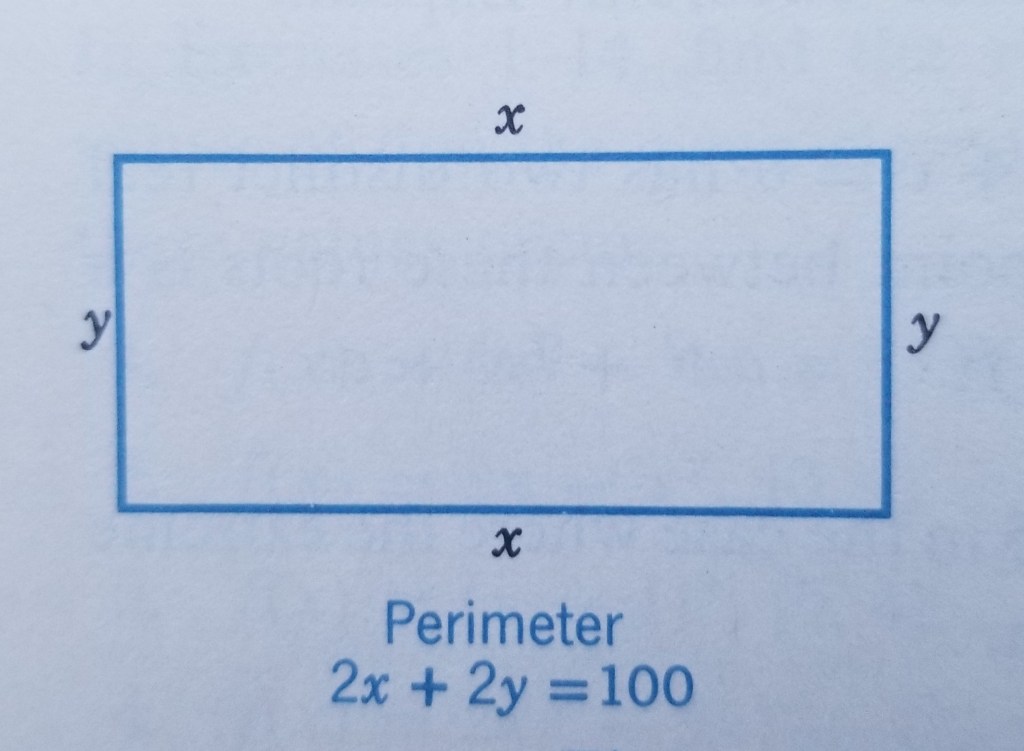
Soln. Let


Then
Since the perimeter of the rectangle is 100 ft, the variables 

Notice, we are told to find the dimensions of the rectangle whose area is largest. We thus have to solve for the dimensions when the area is at a maximum. The formula 

Using substitution,

Because

It can’t equal 

Differentiate 

Create the conditional statement of 

The solution is 

The rectangle of perimeter 100ft with greatest area is a square with sides of length 25ft.
A bit harder of an example
With reference to the diagram below:
An offshore oil well is located in the ocean at a point W, which is 5 mi from the closest shorepoint A on a straight shoreline. The oil is to be piped to a shorepoint B that is 8 mi from A by piping it on a straight line underwater from W to some shorepoint P between A and B and then on to B via a pipe along the shoreline. If the cost of laying pipe is $100,000 per mile underwater and $75,000 per mile over land, where should the point P be located to minimize the cost of laying the pipe?
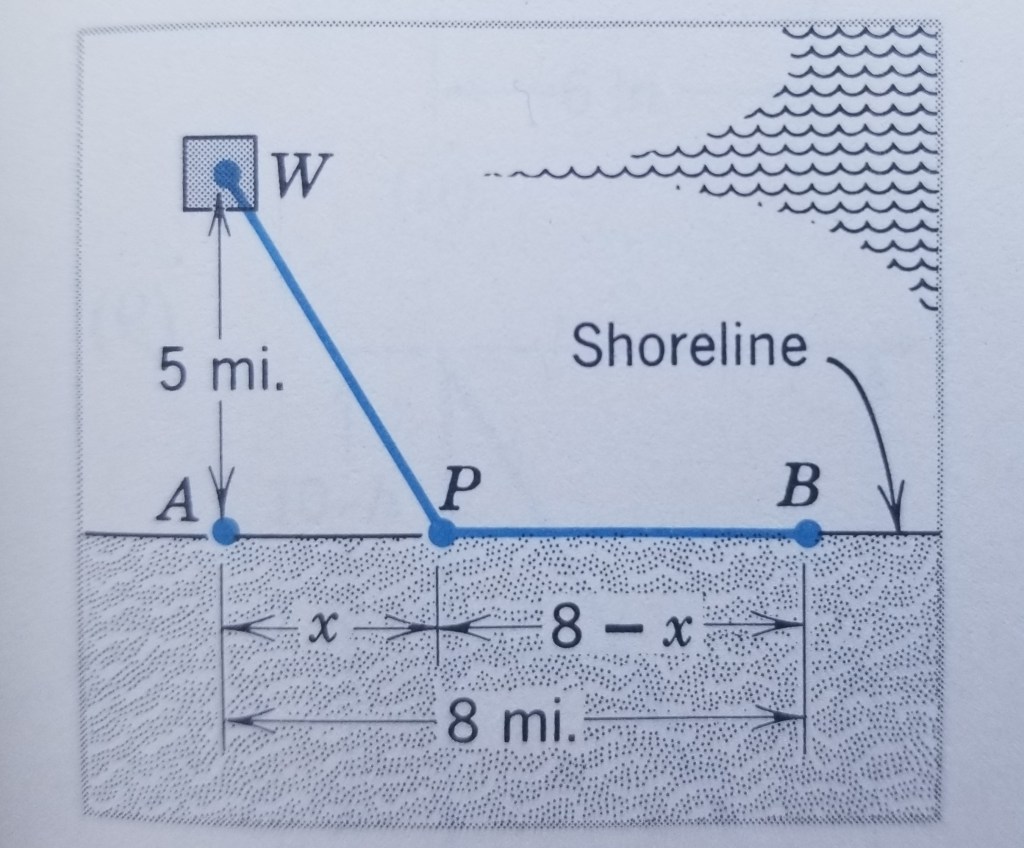
(Remark. The shortest distance between W and B would, indeed, be a straight line. Even though this uses the least amount of pipe, all of it is underwater, which would be expensive to lay. Similarly, a pipeline from W to A to B uses the least amount of expensive underwater pipe, but uses the greatest total amount of pipe. Thus, it is actually best to make a pipeline that goes from W to some point P between A and B and then go on to B. This would incur less total cost than by piping to either extreme location.)
Soln. Let


We see from the diagram that the distance of pipe underwater from W to P is

We also see that the distance between the P and B is

From (i) and (ii), the total cost 

Because the distance between A and B is 8 mi, the distance between A and P must satisfy

(We include the endpoints, since they are practically possible.) In this problem, we have no constraint, which is fine since the formula is already in terms of one variable. Differentiate

Equating 

or

or


The number 


Plugging these values into the cost formula yields
When

When

When

We need the value of 
The distance of P, the point onshore where we pipe the oil to, must be
A harder example
With reference to the diagram below:
Find a point on the curve 
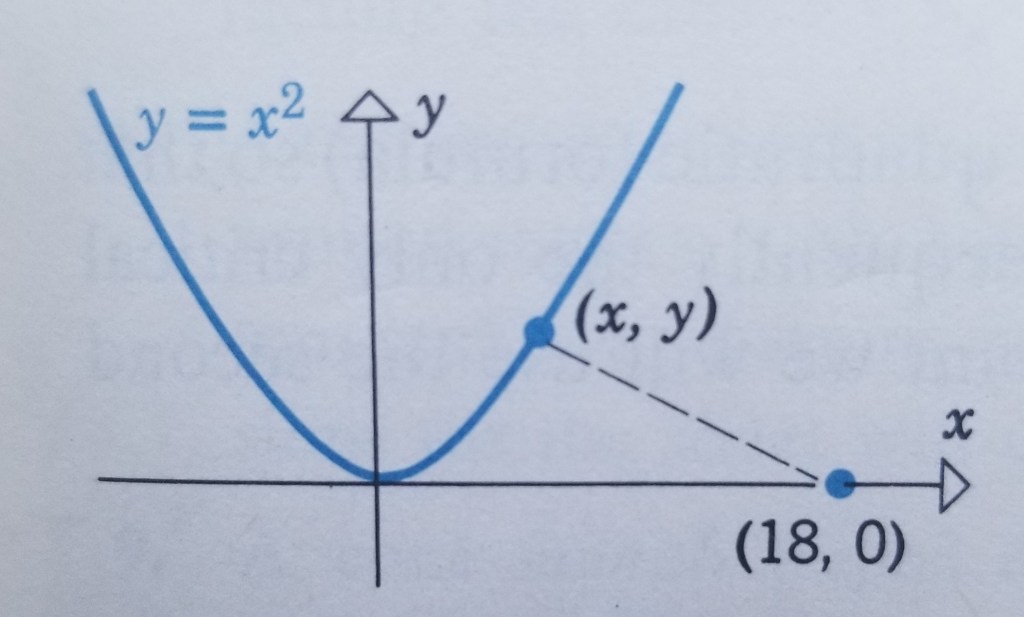
Soln. The distance 


Since

Because there are no restrictions on 
I am going to use a helpful math trick that is based on the following fact: The maxima and minima of a function occur at the same points as the square of that function. Thus, the minimum value of

occur at the same
Differentiate 

Equate to zero:

The only real solution to this conditional statement is 

In summary of optimization problems
These types of problems almost always follow the same procedure.
Step 1: Label the quantities relevant to the problem.
Step 2: Find the formula to be maximized or minimized.
Step 3: Using the conditions stated in the problem to eliminate variables, express the quantity to be maximized or minimized as a function of one variable.
Step 4: Find the interval of possible values for this variable from the physical restrictions in the problem.
Step 5: The rest is mechanical. Differentiate the function. Equate to zero. Find the values of the variable that satisfy that condition. Determine which value is correct via the range and whether it is the appropriate type of extremum.
General Advice
This subject is not as hard as you have been led to believe. Certainly, it is hard to intuit at first, but with many hours of focused study, it will start to become clearer. People who experience zero friction with intellectually-taxing studies do not exist; those you think do simply work hard and often.
For any student just beginning this wonderful yet difficult subject, the following list might provide good advice:
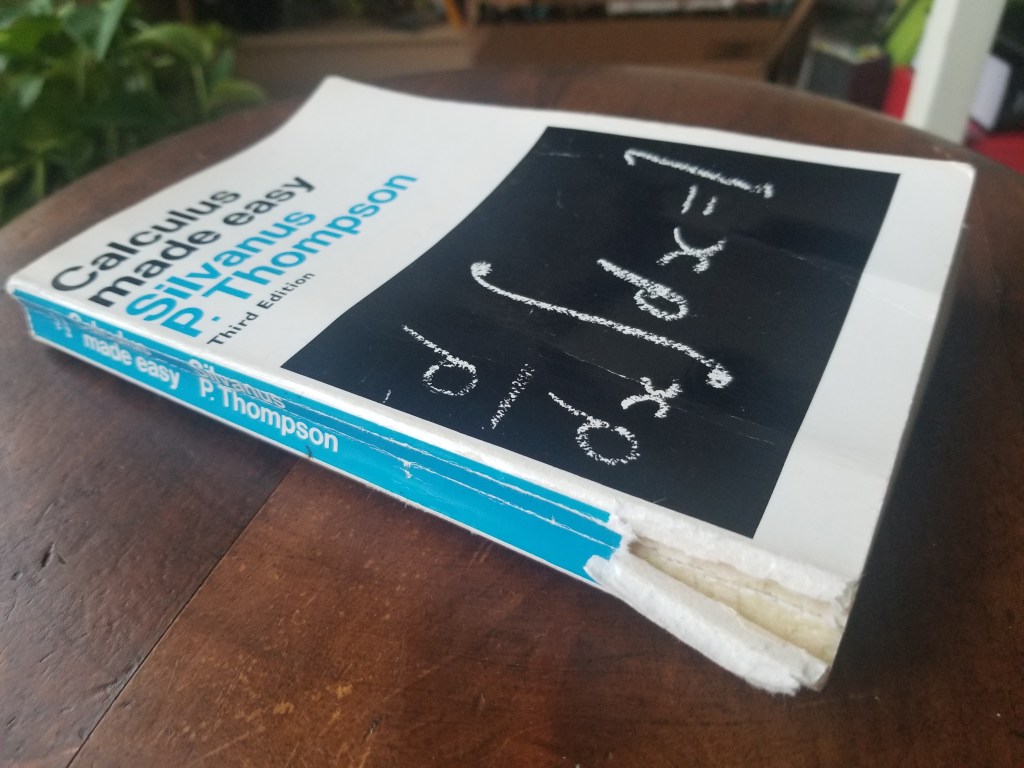
- Read respected books – One reason why my 14-year-old self was able to understand calculus quickly was the literature I used. If you are struggling with this subject, I highly recommend Thompson’s Calculus made easy. The book explains everything extremely well and acknowledges its quasi-complexity. It is not, however, a formal math book, and you should try to get through it as quickly as understanding permits so that more formal textbooks can be tackled.
- Don’t be scared by weird-looking symbols – There are a lot of strange ones in calc; however, they all have precise meanings and will be comforting to see once they are learned.
- Master algebra and trig – Calculus definitely requires a firm understanding of algebra and trigonometry, so be sure to get sufficiently good at those. For me personally, however, I started with only a basic understanding of trig and was able to learn calc efficiently. If I ran across any trigonometry concept I didn’t recognize, I would divert time to learn it.
- Ask questions – It is more productive to be confused and know specifically why than to just be confused. Try to reduce your confusion to specific questions that can actually be answered and then seek answers either by thinking on your own or by consulting an external source. (If you don’t understand parts of this blog, apply this method.)
- Don’t lose the plot – The simplicity will beget complexity. You cannot forget that, at its core, it is made up of the same simple things.
In summary, just work hard. There is no substitute for work, and a skill is impossible to obtain without practicing it frequently. You will often hear mathematicians speak of the beauty of their subject. This probably sounds strange to the layperson, but rigorous study of calculus will make that claim less unreasonable. You will start to see the underlying simplicity of it all and realize why it has to be the way that it is.
And after you have finished the material and are comfortable with the subject, be proud to have such a well-thumbed book on your shelf. It is a very satisfying sign of progress.
- This is an oversimplification of those 2000 years. The decline was primarily in the Western world. Most of the progress made in that time was by China, India, and the Islamic world. Also, the decline is considered to have actually ended about 100 years before the discovery of calculus, with Copernicus’ De Revolutionibus. ↩︎
 Santino's Engineering Blog