
Weeks of hard labor have culminated to this moment, I reminded myself.
The registration process was frustrating (you can expect a blog on it), but the plane finally earned its numbered sticker. At 9 a.m., my father and I drove to the AMA-certified RC field. It was a cool morning, if memory serves, and was the day Augustus would take its first steps into the air and the pages of history.
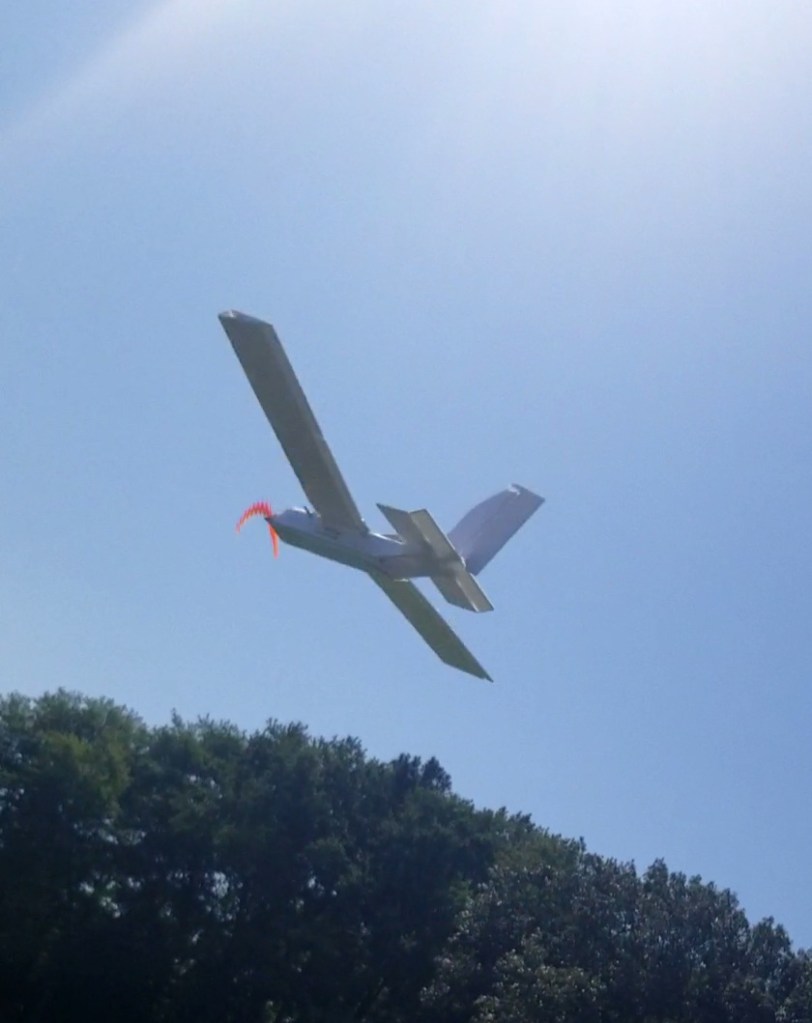
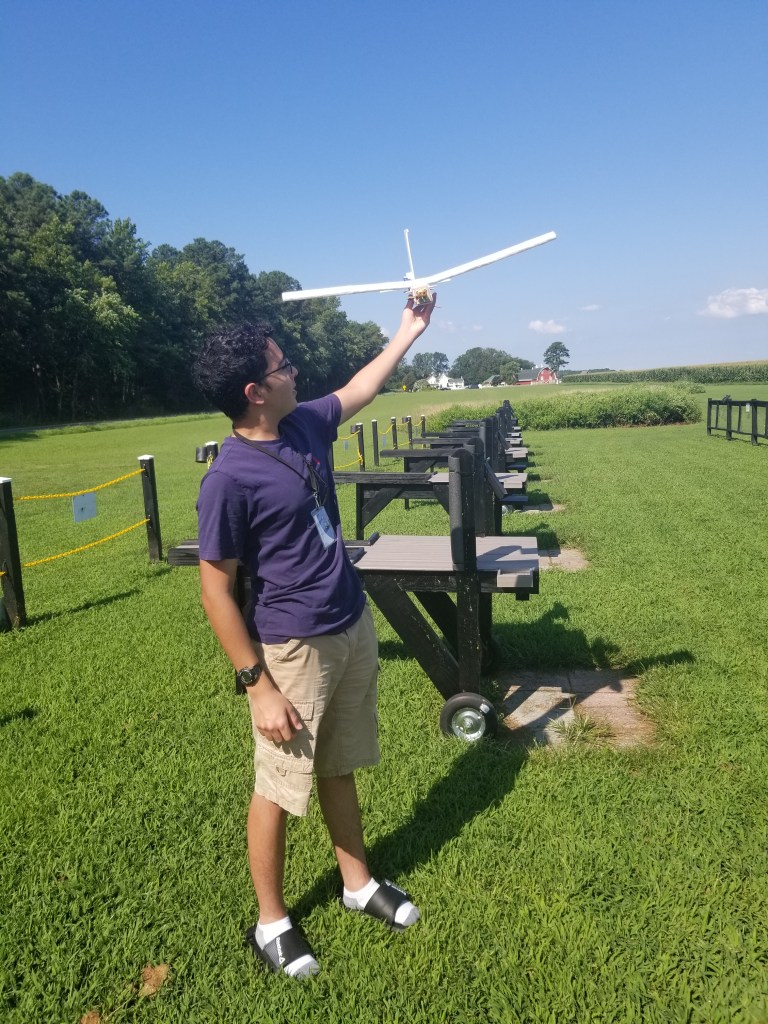
The notion that this plane was perfectly constructed would be wrong. With a fuselage shaped into a lopsided square prism and the center of gravity out of wack from the motor mount’s weight, the success of Augustus was not at all certain (or expected).
More problems arose during the construction process than I care to add, but an important one had to do with the rudder. This control surface favored its right side over its left; that is, it would stick out very far for turning right, but not so much for turning left. I figured Augustus would crash, if not from being really heavy, then from not being able to turn left.
Nevertheless, Aug. 3 was going to be the maiden flight of the 3-channel aircraft.
(I suppose I’ve failed to mention this, but a 3-channel plane—e.g. Augustus—is a plane that has three things you can control via the transmitter. In my case, those channels connect to the motor, the rudder, and the elevator. Apologies if this caused any confusion in previous blogs.)
Arriving at 10 o’clock, I carried Augustus to one of the work benches and started testing each part.
I heard nominal beeps once the battery was connected. The elevator worked. The rudder, though sub-optimal in design, worked. The motor worked and rotated in the correct direction. I put the wings over the fuselage and strapped it down with rubber bands. It was time.
The grass was wet with dew and incredibly green. My father (who crashed the proof of concept, incidentally) was tasked with throwing the plane in one hand and recording the flight in the other. Two conflicting priorities, we realized, but it was necessary. He walked out onto the field with Augustus, holding the camera awkwardly.
With Augustus held up high in my father’s hand, I tested the control surfaces once more. Nominal responses to everything.
Revving the motor to three-quarter’s throttle, I motioned to my father to throw. And…
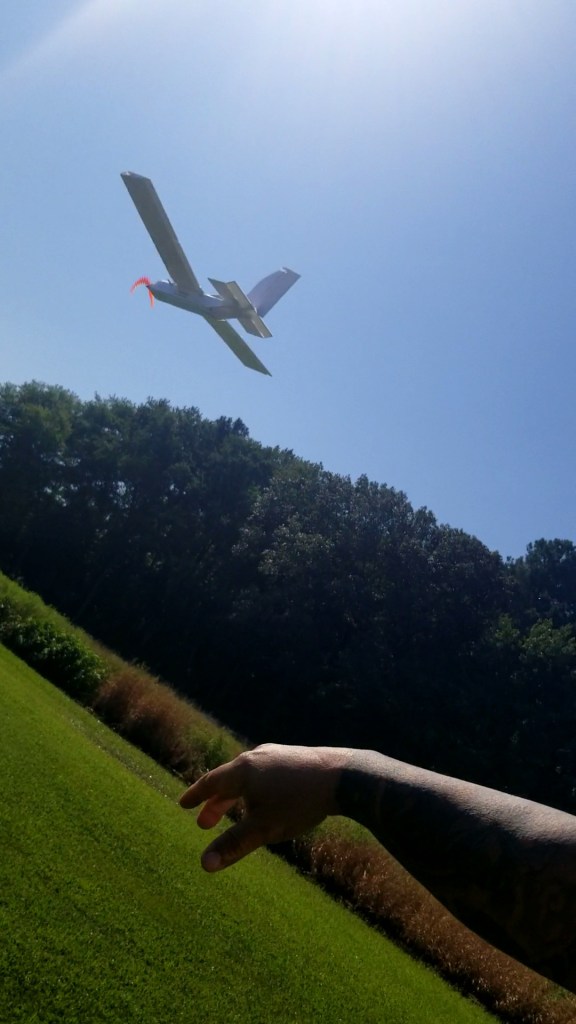
Not really. This is a screenshot.
It nosedived immediately.
Looking over the wreckage, it was still in good shape. The propeller, however, was bent severely. Still flyable, I declared.
We weren’t going to throw it in its current form, though. It was nose-heavy, far too nose-heavy. To fix the imbalance, we put a small wrench into the back of the plane, hoping that the center of gravity would move back enough to allow for flight.
Going back into our previous positions, we tested the motor, elevator and rudder, all of which worked perfectly. Pushing the throttle lever up, I gave the signal.
It rose into the air and…

It crashed badly.
When in the air, it pitched up a lot. I suppose it was tail-heavy, or perhaps I had the elevator down too far. In either case, Augustus had fallen and was not going to fly again.
Through an optimistic lens, there are a lot of things I learned from this process, things which I will certainly implement in the next design. If you are interested in building an RC plane, perhaps you will find the following tips useful.
- Make a good fuselage – It looks nicer if you take your time with it.
- Don’t make an unnecessarily heavy motor case – you’ll regret it.
- Make sure the rudder turns equally in both directions.
- Use a motor that is powerful – I didn’t mention this, but my motor seemed a bit weak.
- Have either a tripod or another person present who can film the flight.
- Make sure the center of gravity is in a good place – 1.5 inches from the leading edge is a good rule of thumb.
I shouldn’t say that I was surprised, since I figured the motor case was too heavy. The criteria of success were modest, though: If I can recover the electronics, it’s a success.
The ‘flight’ of Augustus was thus a success.
I will learn from my mistakes and prevent their presence in the next plane: Tiberius, the second emperor of Rome. There are still more rungs before me.
Ad caelum!
 Santino's Engineering Blog