
Poor safety protocols caused the demise of Tiberius. Nothing else.
Therefore, when building its successor, I didn’t deviate very far from the original design: It still had the Aeroscout motor, streamlined rudder, and ample surface allocated to the flaps.
This blog briefly describes the construction process I followed when building my third 3-channel RC plane, Caligula. If more detail about the build is desired, my previous blog elaborates on the process for Tiberius.

Starting with the fuselage, I cut foam board into the shape of a square prism and reinforced the inside with packaging tape. To extend its length, I attached some excess fuselage from the Tiberius build.
For the tail, Tiberius’ design was both aesthetically pleasing and structurally practical, so I just rebuilt it.
The wings of Caligula were the same ones used on Augustus and Tiberius. Also near the front, the motor mount was hot glued excessively in its position. (As a side note, this mount was the same one used for Tiberius.)
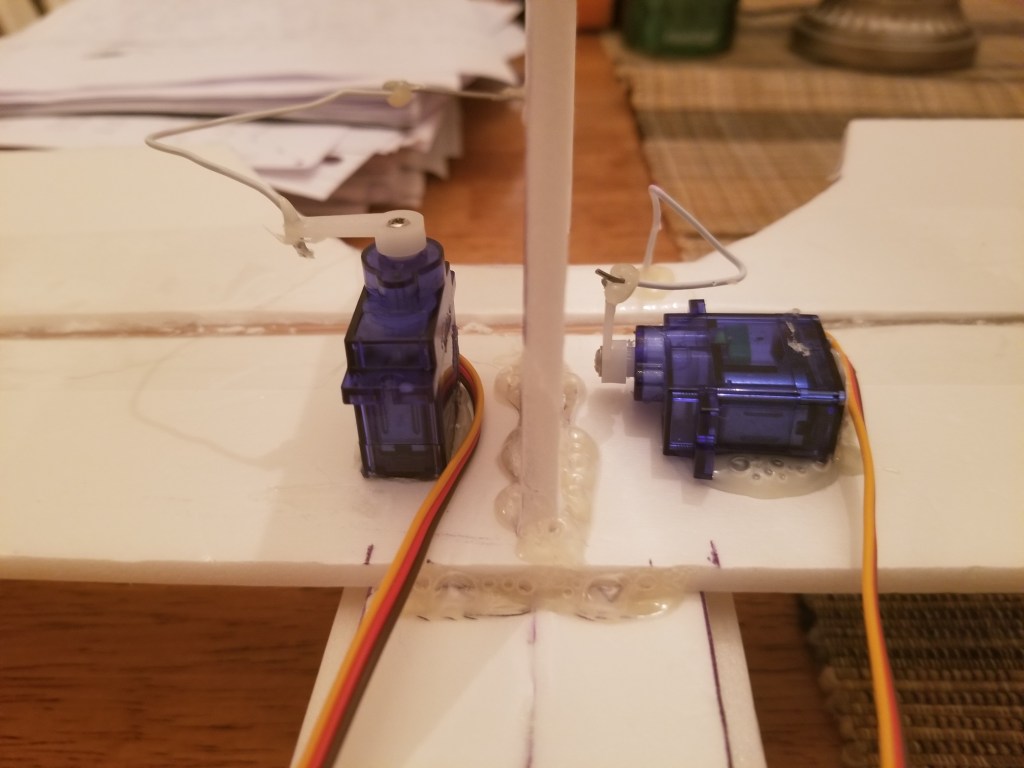
Now, the servos:
One of the problems I noticed with all of the previous designs was how little the control surfaces would move. The rudder was especially bad, barely pivoting in either direction. Luckily, a seasoned hobbyists noticed this and advised me to purchase longer servo horns. Procrastination, however, delayed this until it was too late. Another approach was therefore necessary.
At first, I was going to solder two paper clips together that I could then attach to my currently short servo horn with super glue. A couple of problems arose from this. For one thing, the soldering iron wouldn’t melt the solder. For another, the glue wasn’t strong enough to be used on the servo. That was the end of that idea.
As an alternative, I took those same paper clips, hot glued them together, and then hot glued them to the servo. It wasn’t perfect, but nothing in this RC program is, so I considered it fine.
Last were the electronics:
When I was connecting everything, I found that Caligula was too long. So long, in fact, that the receiver was unable to sit flat when the servos and ESC were connected.

Since flight was the only goal for that mission (not necessarily good flight), I considered the potential drag to be acceptable.
Hooking the battery up in the front, I tested every channel and received good callbacks.
Did you notice that I said “front”? This is the new location for the LiPo battery and is the implementation of a lesson I learned from Tiberius. Namely, a tail-heavy design is a cardinal sin in aeronautics!
With Caligula finished, all that is left is to take it out to the field and send it!
Ad caelum!
 Santino's Engineering Blog