
Over the past four months, I have been designing, building, and flying radio-controlled (RC) planes. While many of my blogs regarding this topic focus on the construction and testing of these model aircraft, this blog summarizes the progress I have made and future plans I have. Essentially, this will reflect on the state of my RC hobby.
Augustus…
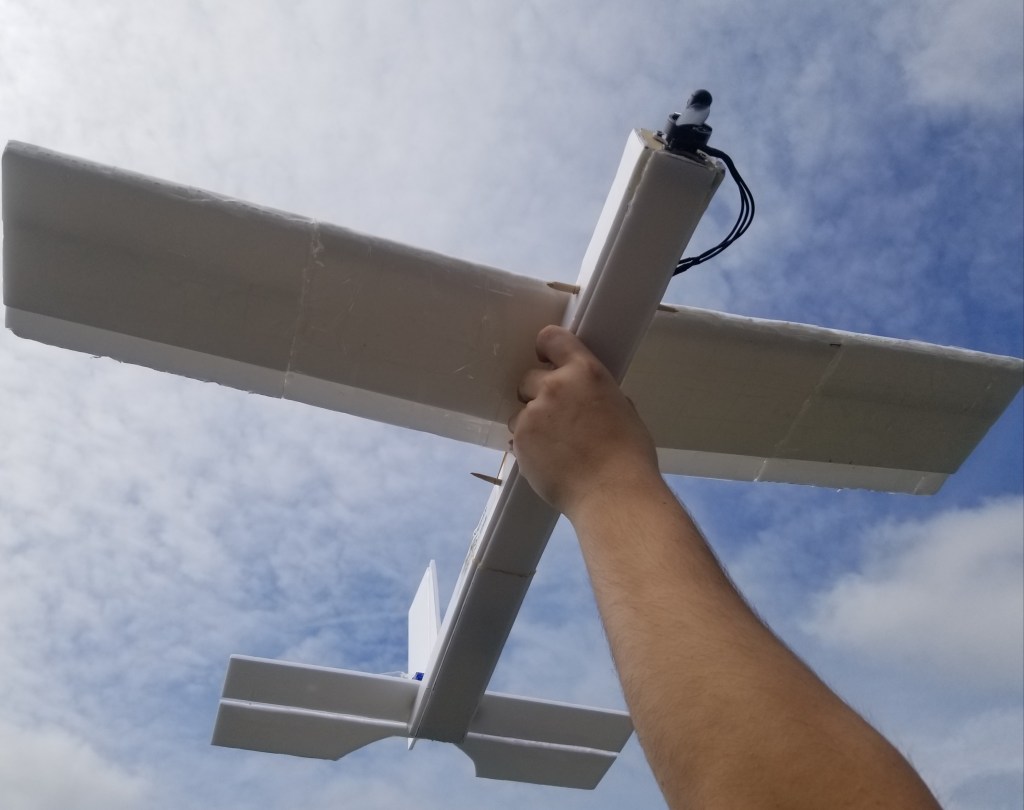
Named after the first emperor of Rome, this plane was flawed by the following:
- excessive weight,
- poorly-placed center of gravity (CG),
- weak motor,
- small pivot angle for control surfaces.
Being my first 3-channel model aircraft, mistakes are likely to abound, but the lessons were directly proportional with these.
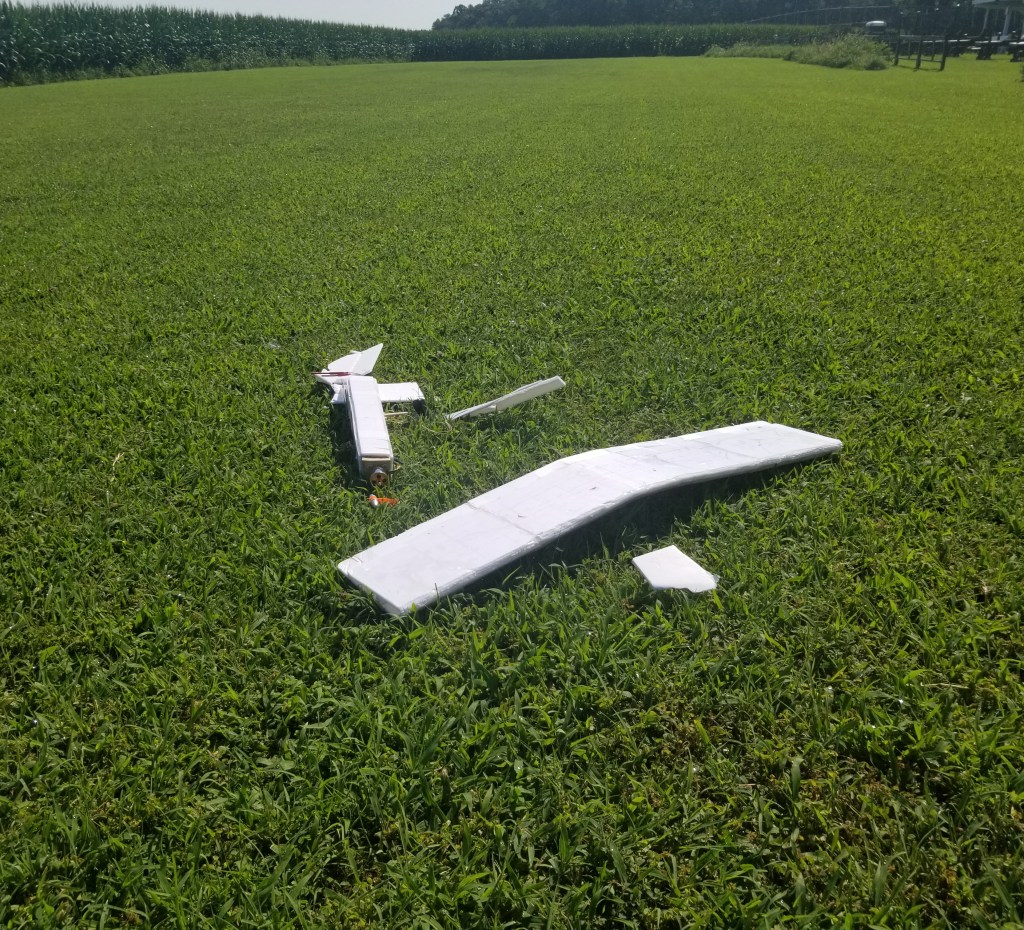
As for Augustus’ flight, this photo says it all.
After that event, deep rumination led to the birth of a new design. This one would feature several improvements, including a lighter motor mount, better servo rods, and a rearward CG.
Swiftly, I set upon constructing the next plane in line.
Tiberius…
Named after the second Roman emperor, this iteration was superior in nearly all dimensions compared to its predecessor. With lessons learned from Augustus implemented into the very particulates of the foam board, its structure was robust yet light-weight. Additional changes not related to Augustus were also added; chief among them was the elevator, whose increased surface area and carved out middle provided more lift.
This is not to say, however, that Tiberius had no flaws. Much like its namesake, this plane had a few design imperfections, notably its tail-heaviness. With the battery positioned in the rear, the CG was pushed too far back, causing the plane to stall before any actual lift could be generated.
Unlike Augustus, though, its demise was on the workbench, not on the field.

I accidentally turned on the motor while it sat on the platform, causing it to tear itself apart as it repeatedly hit the table with its propeller.
The number of lessons learned this time around was fewer than Augustus. In fact, I can only really think of two: make the plane nose-heavy and follow a safety protocol.
This lack of design insights meant that the next plane I built would be essentially identical.
Caligula…
All of this brings me to my most recent plane: Caligula. With the heavy battery now positioned forward, the resulting flight could actually be considered a flight. It was in the air for perhaps 2-3 seconds as it steadily lost altitude. From this test, I discovered a massive flaw that had been pervading all of my RC planes: They were all too heavy.
This came as a complete surprise to me. Up to that point, my belief was that the only thing preventing a perfect flight was the placement of the CG.
Its crash landing resulted in little more than a broken propeller.

Reflection
You aren’t learning if you aren’t failing. Thus, I am not embarrassed to say that many of these were failures. I would argue, however, that the binary system of “Failure” and “Success” is too constrictive to encapsulate the intricacies of each test. To me, there is a continuum between these two extremities, and while all of these tests lean toward failure, each subsequent iteration lands closer to success.
The next plane I will be building is named after the fourth emperor of Rome, Claudius. I have yet to start constructing it, but I have an idea of what needs to be done.
- Lighter wings
- a CG that is 1.25 in. behind the leading edge
- Smaller control surfaces
- One piece of wood for the motor mount
- And extension cords for servos
Future plans
Projecting forward, there are a few things I would like to experiment with in regards to the RC hobby.
Currently, my goal is to simply construct a plane that can fly for a few seconds. Once I make one that achieves 10 seconds of flight, I will focus my attention on refining flight performance.
After I perfect the design, I would like to try a more complex aircraft, perhaps even one featuring 3D-printed parts. Drones would also be welcome brain food for me.
Unrelated to the RC planes but still in the same area of engineering, my rocket hobby has yet to take off the ground. I have asked my RC field if I could fly a rocket on their property, to which they politely said no, since the FAA only allows them to fly to 400 ft. and my rocket would fly 600 ft. I have yet to find another place to launch it.
There is no shortage of things I need to do.
Ad caelum!
 Santino's Engineering Blog