
The temperatures have continued their gentle decline as planet Earth’s geographic north pole has strayed farther and farther from the sun. Nevertheless, the warmth provided by sweaters and experimental aircraft kept all of us comfortable that morning.
Indeed, with the confidence I felt in the upcoming flight, I might have mistaken the season as spring.
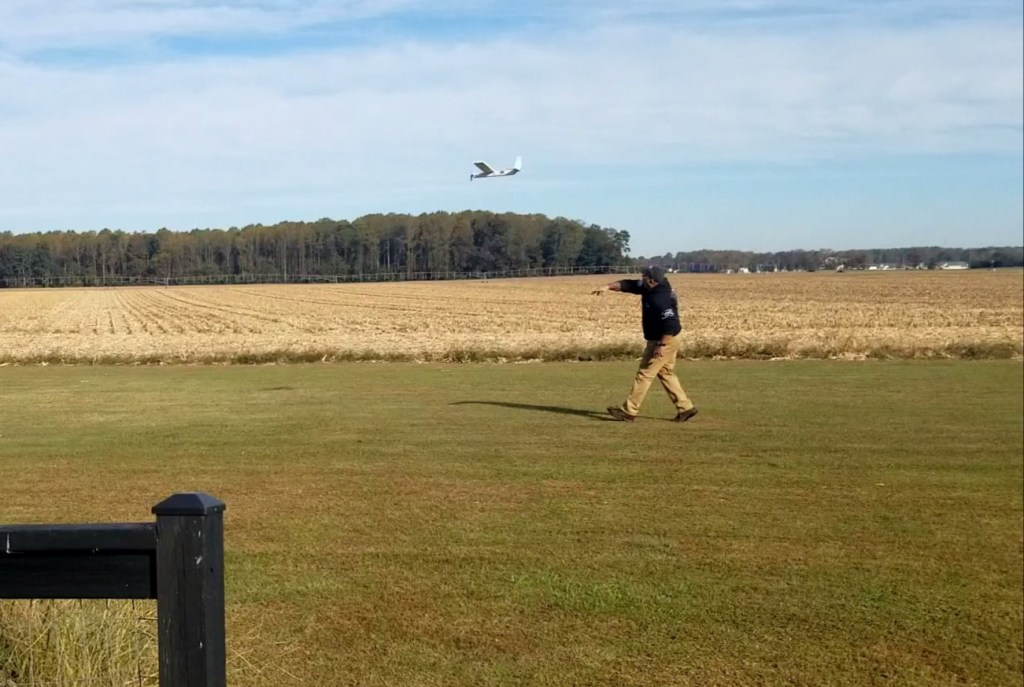
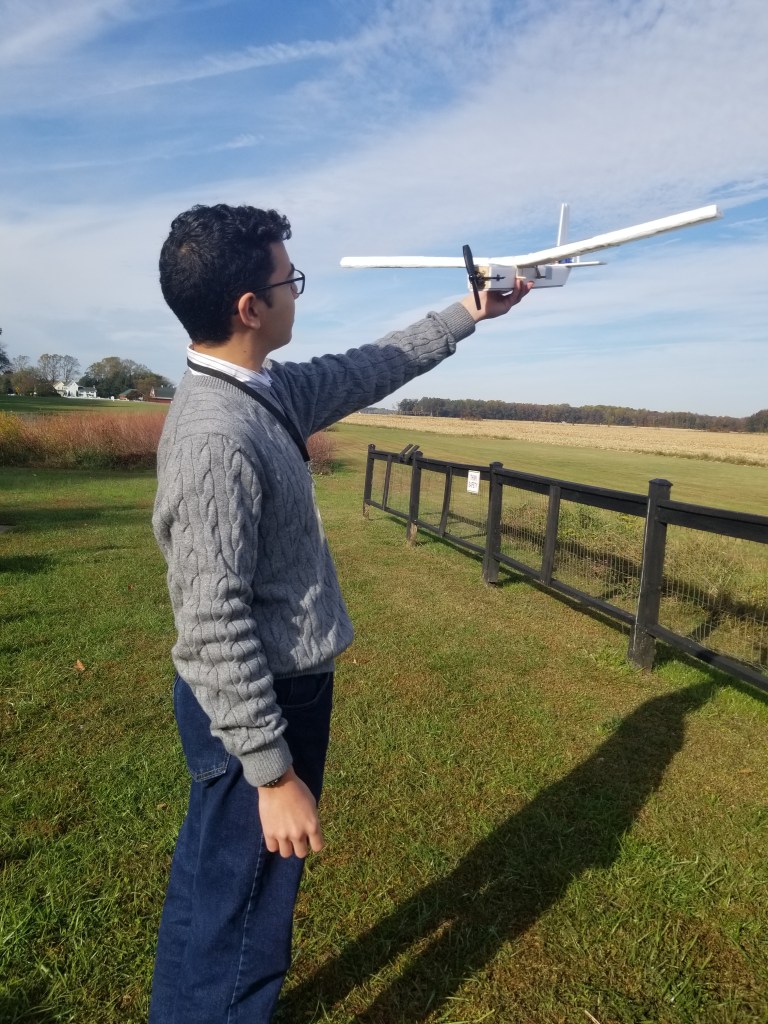
Embarking soon after sunrise, we arrived in step with the large morning attendance and immediately started to unload the newest iteration of the 3-channel RC plane.
With its new weight-reducing features, Claudius was the lightest aircraft I had ever built. Some notable improvements were the smaller tail assembly, lighter motor mount, and shorter fuselage, all of which were readily perceived (and approved) by the seasoned hobbyists present.
Once my collaborator set Claudius down on a workbench, I connected the 3S LiPo and tested each part:
Elevator pivoted nominally
Rudder pivoted nominally
Motor spun nominally.
After turning on the GPS tracker (which I remembered to bring this time), I walked a number of steps away and glanced at my phone to see if the tracker app could spot it. It couldn’t. (Perhaps hunting for the best price isn’t always the best strategy.) Nevertheless, I allowed it to remain on board, since the beeping feature still worked.
With each component in working condition, Claudius was carried to the middle of the grass runway by my father.
“On the field,” my father notified the club members.
After checking for any range issues, I shouted to my father we were go for flight and announced each step in the launch sequence.
“Motor at full throttle!”
You could hear those 20,000 rpm.
“Elevator down!”
I could see it pivot.
“Send it!”
As I motioned to my father to throw, I remember one of the seasoned hobbyists yelling something like “No, elevator up! Elevator up!”

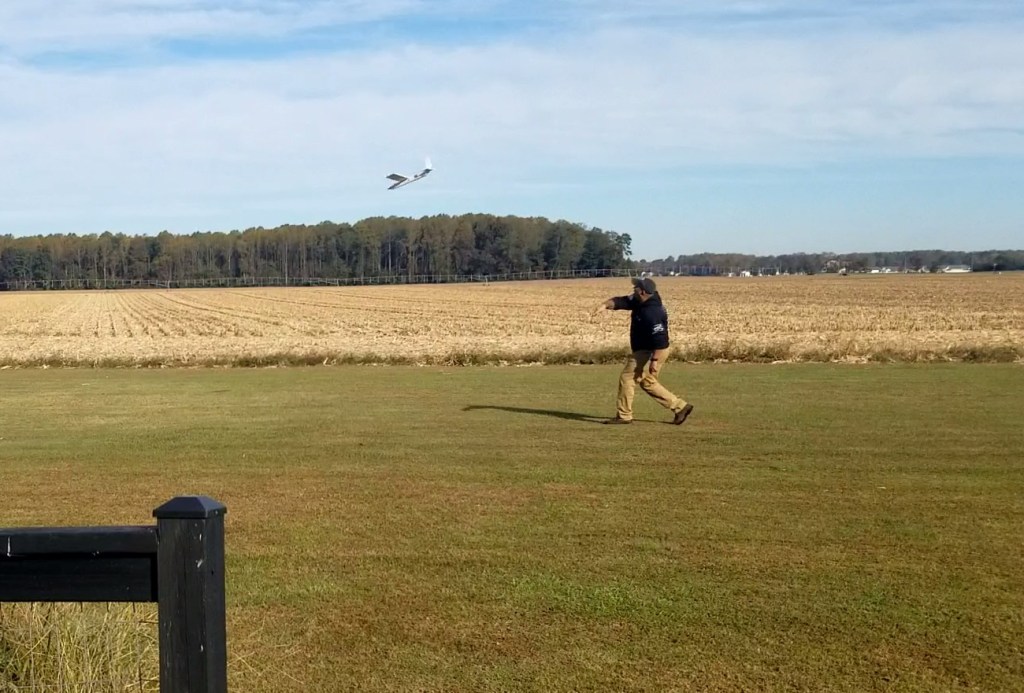
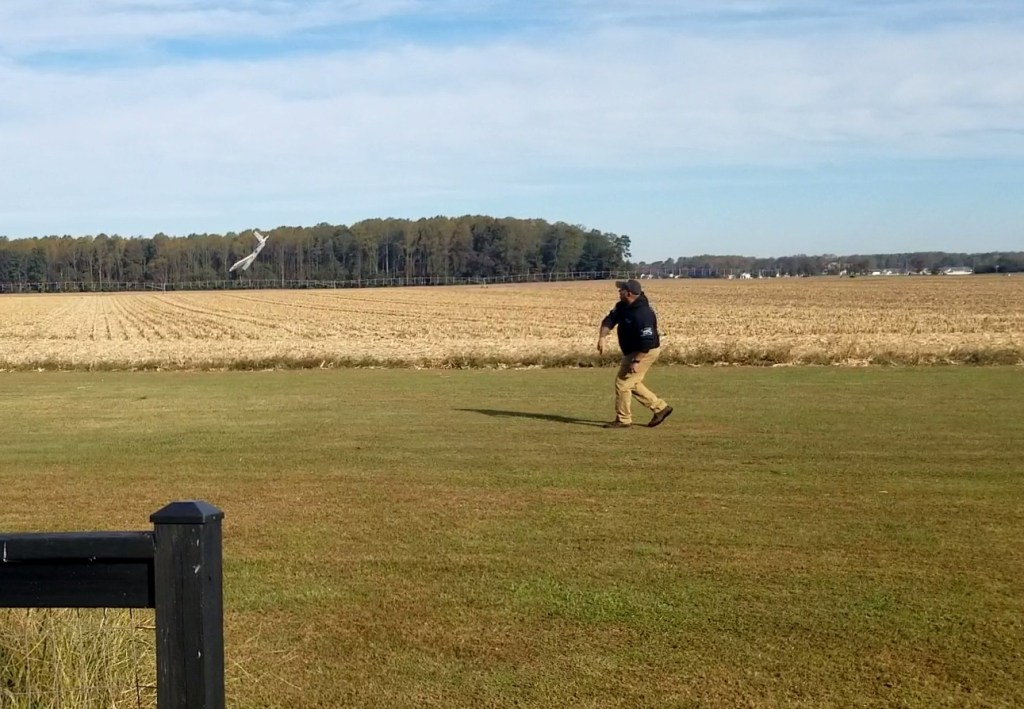

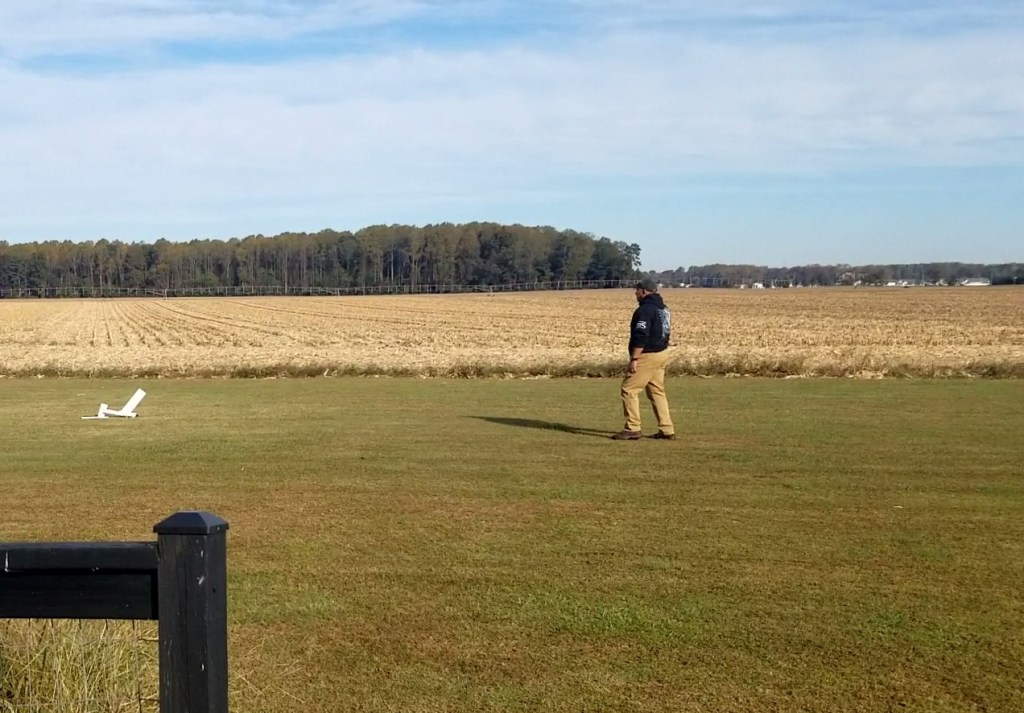
Whoops…
When speaking with the hobbyist afterward, I clarified that by “elevator down,” I meant I moved the joystick down, which is the correct thing to do. However, as the hobbyist discovered, my controls were reversed: Moving the joystick down moved the elevator down, instead of properly pivoting it up. With this configuration, the plane nosedived.
The damage:
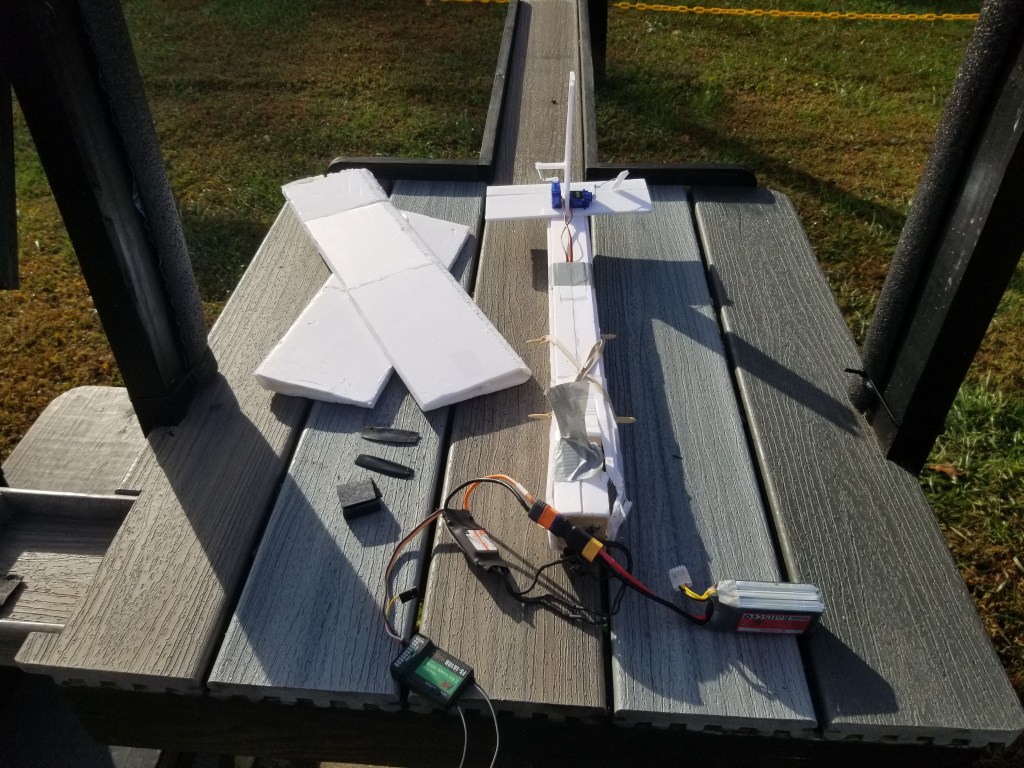
A broken propeller, snapped wings, and a ruined fuselage.
At the very least, the flight did validate the effectiveness of the elevator: When it was down, the plane went down. Therefore, I think it’s safe to assume that if it were up, the plane would have gone up.
In addition to this fact, I also learned several protocols to implement:
- Check beforehand that the elevator moves in the correct direction: When you move the joystick down, the elevator should go up. When you move the joystick up, the elevator should go down.
- Also be sure the rudder and motor move/spin in the correct directions. (I checked the rudder before the flight but forgot to check the motor. Luckily, it spun correctly.)
- Reinforce the wings with carbon fiber spars. For Claudius’ wings, I glued foam spars along the inside, but this was not strong enough, especially since I removed the packaging tape that strengthened them. (I’m certain this is true because those wings had previously survived three other crashes when they had the tape.)
So, it seems the main problem here is analogous to Tiberius’: protocol, protocol, and protocol.
I do, however, consider this a flight … just not a successful one. Considering the plane was clearly directed downward by the elevator and not by its own weight, I believe my courageous campaign on excessive weight succeeded. Moreover, the agility premiered in the footage proves the efficacy of the elevator design. With all of this proof, therefore, the next plane will be nearly identical to Claudius, differing only in the material used for the spar.
Ad caelum!
 Santino's Engineering Blog