
In linear algebra, we are occasionally interested in resolving vectors into their “projections.” In contrast with components, however, which are determined with respect to the x- and y-axis, projections are determined with respect to an adjacent vector, one that shares the same initial point.
This blog discusses the derivation of formulas that help us in finding these projections.
Suppose we have two nonzero vectors u and v in 2-space. The vector u can be written as a sum of vectors, say, 


where
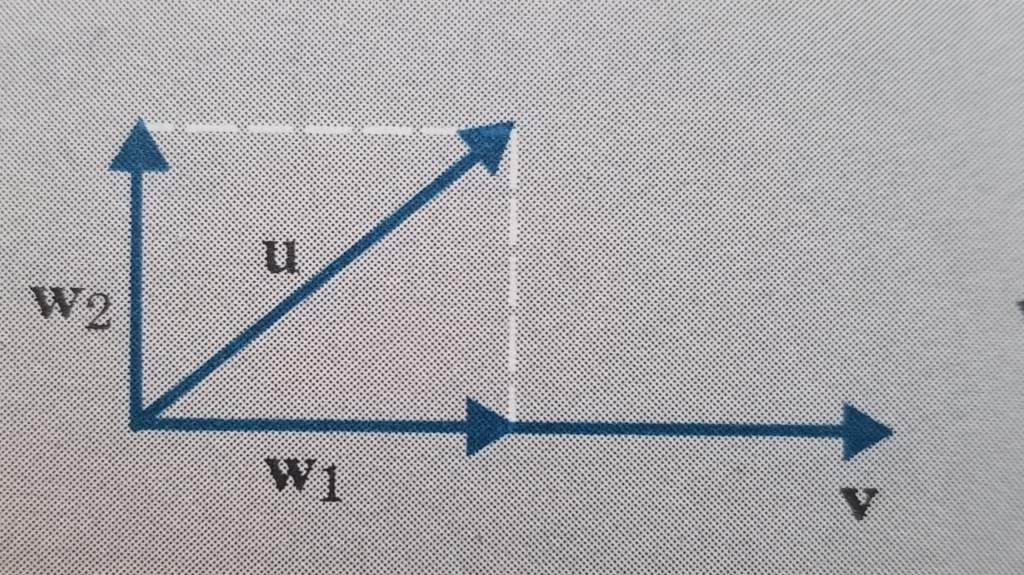
In the diagram, vector
Since

where k is a scalar.
The formulas we are in pursuit of are those that express

To get rid of


Notice that 


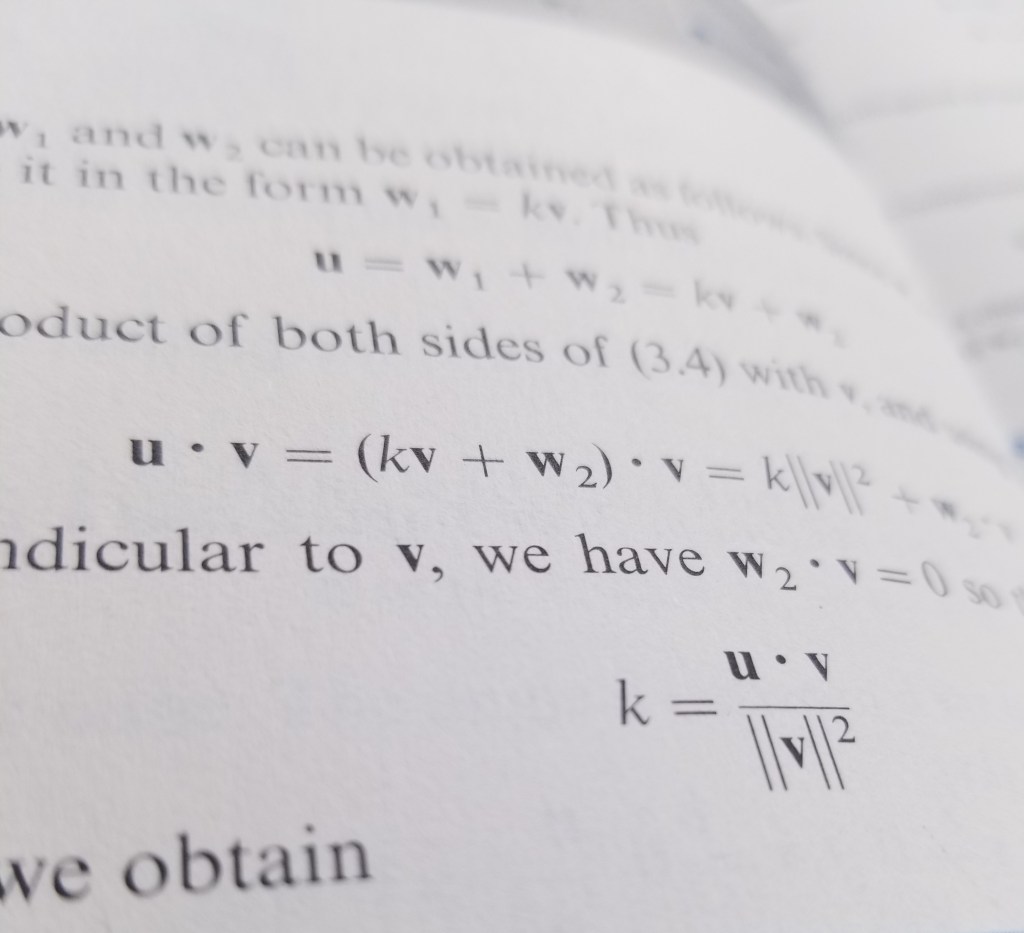
Solving for k,

Good. Now we have the scalar k in terms of just u and v. From here, we simply substitute k into (ii):

We have successfully derived the formula for the orthogonal projection of u on v. Now, we can substitute this into our vector sum from earlier (

Solve for

Done! We have just derived general formulas for the projections of u with respect to an adjacent vector v. All that is necessary from the user’s end is to plug in the components of each vector, solve a couple of dot products, and recall how to calculate the norms of vectors.
A wonderful derivation, indeed!
 Santino's Engineering Blog