The other day, I ran into a pleasantly difficult math problem concerning intersecting cylinders, the solution of which involved quite a bit of imagination. It took some time until the key insight dawned on me, but after that, the math was very straightforward.
The problem is from the second edition of “Calculus With Analytic Geometry” by Howard Anton; accordingly, all credit goes to him for the exercise which I reproduce below (the solution, however, is my own):
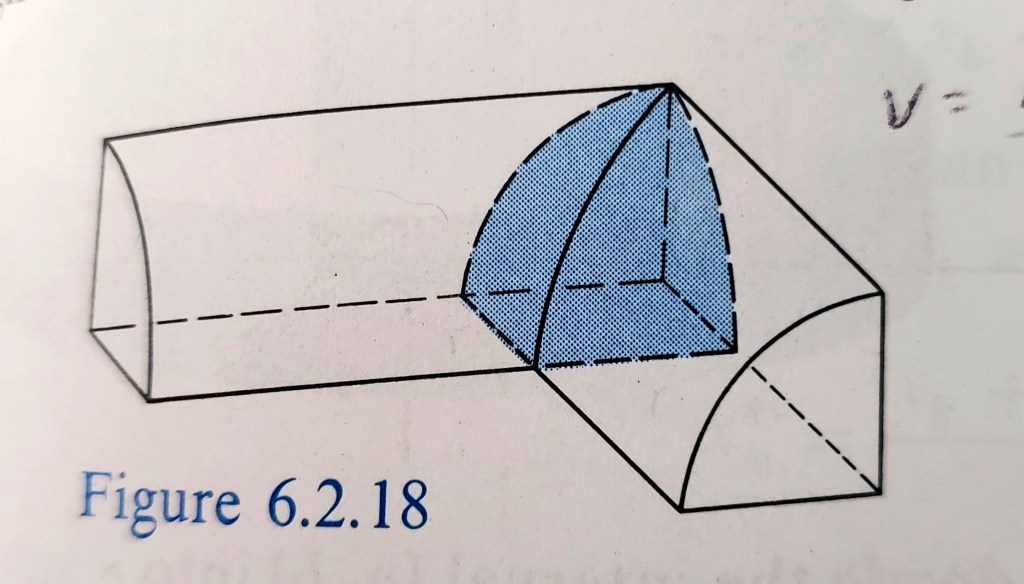
Two right-circular cylinders of radius r have axes that intersect at right angles. Find the volume of the solid common to the two cylinders. [Hint: One eighth of the solid is sketched in Figure 6.2.18.]
In the tradition of Sal Khan, if you haven’t already, take a stab at the above problem before reading my solution.
Soln.
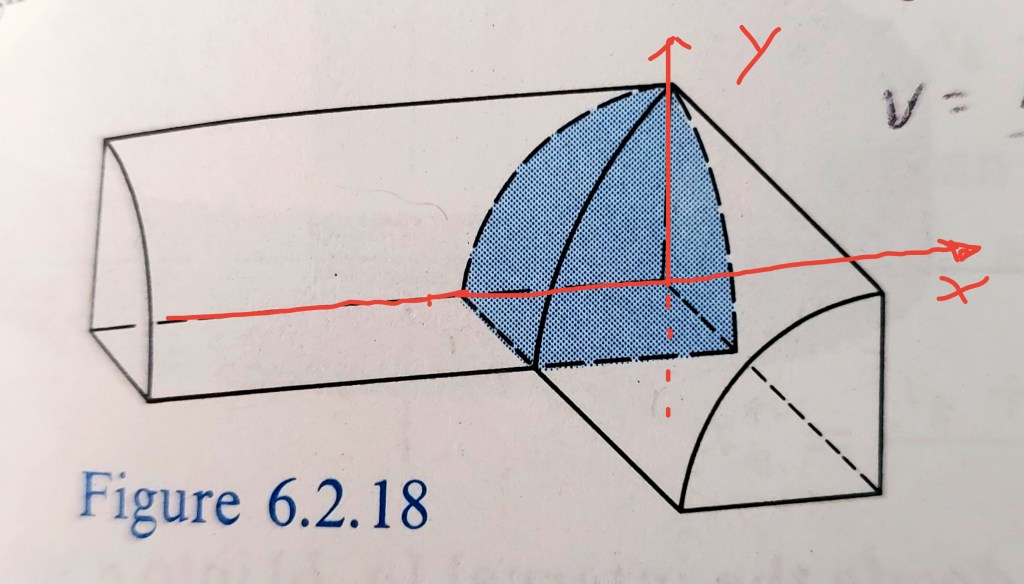
To calculate the volume, I took the approach of summing up (i.e., taking the integral of) all of the cross-sectional areas perpendicular to the y-axis. If you create coordinate axes like below, where the y-axis is perpendicular to the plane of intersection and goes through the top and bottom vertices of the shape,
the cross-sections perpendicular to the y-axes are squares of varying areas. This fact can be seen by looking down on the two cylinders. They look like rectangles, and their common area looks to be a square. It doesn’t take too much additional imagination to then realize that every cross-section perpendicular to the y-axis is also a square, just of different area.
Now, with that well understood, it is evident that our moral objective as amateur mathematicians is to determine how the cross-sectional area of these squares vary with y. That is, we are trying to find a function A(y) that tells us what the area of the square is for every -r ≤ y ≤ r. (Note: Those certainly would be the bounds of the shape, since the height of the total shape is the diameter of the cylinder, and so, from the origin, the shape stretches up to r and stretches down to negative r). Finding the volume would then boil down to a trivial application of integral calculus: We integrate the function with respect to y between the limits of integration -r and r.
So how exactly does the area vary with y? This is the tricky thing that kept me occupied for more hours than I am frankly willing to disclose.
I realized early on in my thinking that the circular cross-section of these cylinders would be my savior, for it would nicely relate the y with x. But at what angle must we look at the common volume to see a circular cross-section? Again, act on your buzzing inclination to figure this out.
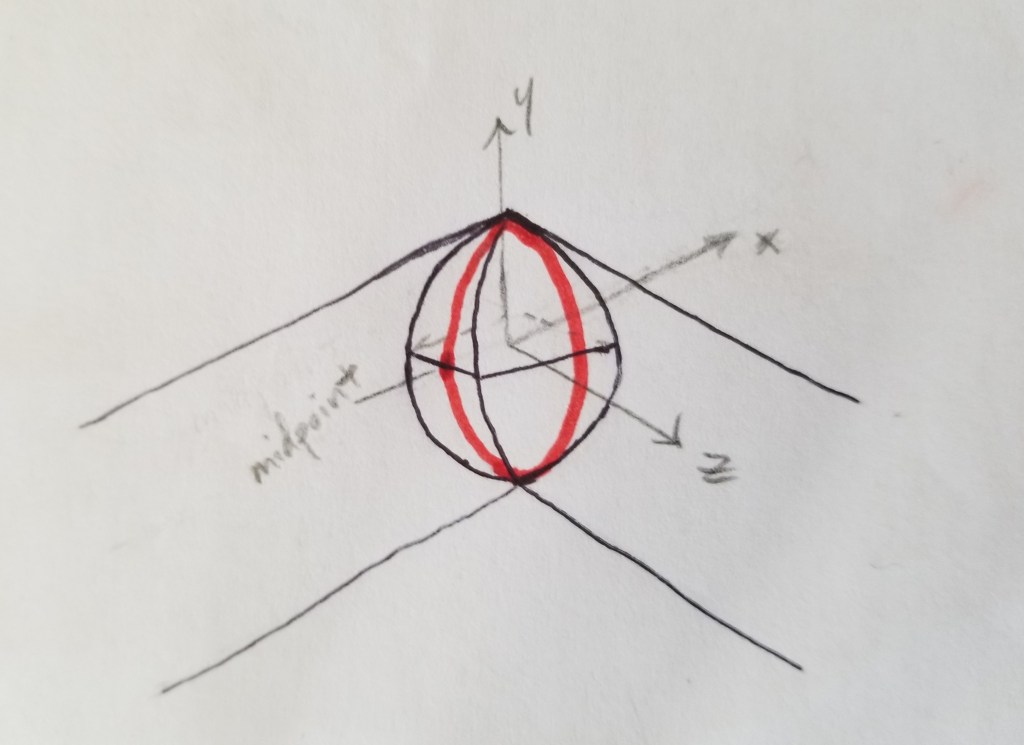
As it seems to me, the circular cross-section of radius r can be found intersecting the midpoints of the equatorial edge. This is sort of hard for me to explain in words, so here is a diagram showing it:
If you were looking at the shape from the z-dimension, you would see a circular cross-section. There is also another one that can be seen by looking along the x-axis, but we will focus on the above shown cross-section.
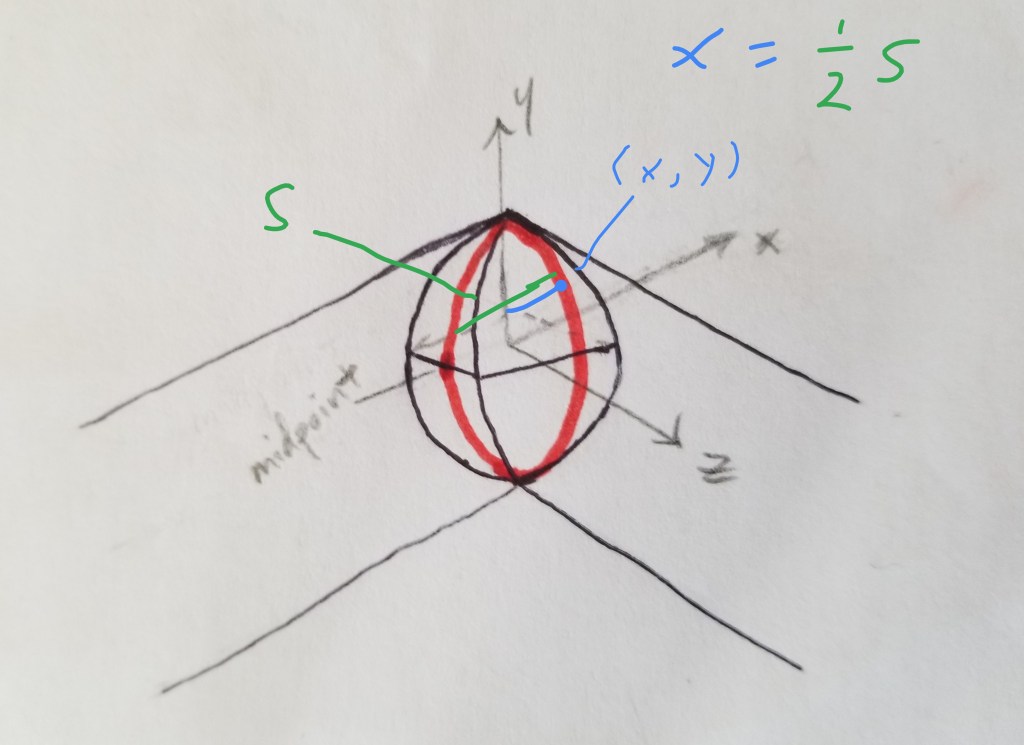
This is an incredibly handy insight, since a chord at any given y within the boundary of the circle, if drawn parallel to the plane of intersection, would be equal to the side length of the square at that y-value. It is then seen that, using the previously established coordinate system, the x-value that corresponds with a y-value (for a point on the circle) is half the side length.
From this information, we can calculate the area of the cross-sectional squares as a function of y:
We know that the equation of this circle of radius r, which has its center at the origin, is
The x that corresponds with a given y can then be found as
x is simply half the side length, as previously mentioned. Multiply both sides by 2 in order to obtain the side length:
Square both sides now to find the area of the square at a given y:
We can then imagine cutting the shape’s volume into square slices. An arbitrary slice would have a cross-sectional area of A(y) and a thickness of dy (an infinitesimal thickness). The volume of this arbitrary slice would be A(y)dy. Since the thickness of each slice is infinitesimally small, we have an infinite number of these slices. The volume of the entire shape would then be the sum of the infinite number of slices, a sum which we obtain with the following integral:
Though, due to the volume of the top portion (from 0 to r) equaling the volume of the bottom portion (from -r to 0), this integral can be simplified by realizing that the entire volume to just twice the volume of the top portion:
Thus, the volume of the common area between those two intersecting cylinders is .



![= 8\int_{0}^{r}(r^2-y^2)dy = 8\left[r^2y-\frac{y^3}{3}\right]_{0}^{r} = 8\left(r^3-\frac{r^3}{3}\right) = 8\left(\frac{2}{3}r^3\right) = \frac{16}{3}r^3](https://s0.wp.com/latex.php?latex=%3D+8%5Cint_%7B0%7D%5E%7Br%7D%28r%5E2-y%5E2%29dy+%3D+8%5Cleft%5Br%5E2y-%5Cfrac%7By%5E3%7D%7B3%7D%5Cright%5D_%7B0%7D%5E%7Br%7D+%3D+8%5Cleft%28r%5E3-%5Cfrac%7Br%5E3%7D%7B3%7D%5Cright%29+%3D+8%5Cleft%28%5Cfrac%7B2%7D%7B3%7Dr%5E3%5Cright%29+%3D+%5Cfrac%7B16%7D%7B3%7Dr%5E3&bg=ffffff&fg=222222&s=2&c=20201002)


